THE CHALLENGE
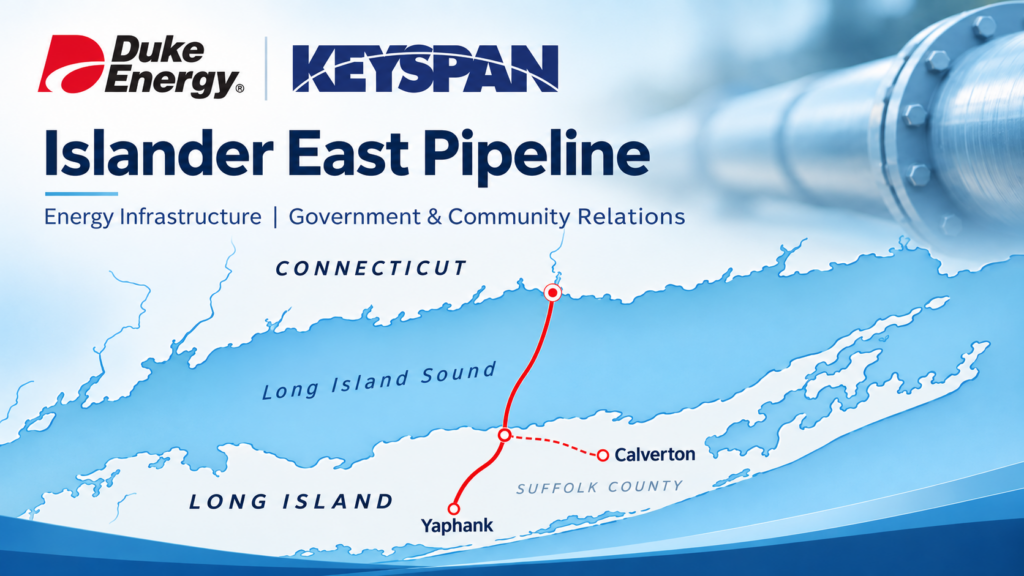
Mark Grossman was retained to provide Long Island public relations and government relations counsel for Islander East, a proposed interstate natural gas pipeline jointly developed by Duke Energy and KeySpan.
The pipeline was designed to bring additional natural gas supplies from New England across Long Island Sound and onto Long Island, where limited supply and infrastructure were constraining access to natural gas in portions of the region.
The Long Island portion of the project presented significant public-affairs challenges. The proposed route crossed multiple communities and environmentally sensitive areas, including portions of the Long Island Pine Barrens, which sit above the region’s sole-source aquifer. Pipeline safety was also a public concern, heightened by memories of a major pipeline explosion elsewhere in the Northeast.
THE APPROACH
Grossman provided Duke Energy with an integrated Long Island public-affairs strategy encompassing government relations, media relations, community outreach, and stakeholder engagement.
Early in the process, he helped identify property owners, political figures, civic leaders, municipal officials, and other stakeholders along the proposed route so that concerns could be addressed directly rather than after opposition had hardened.
That outreach included individual meetings with civic leaders and residents, briefings with elected officials and government agencies, community information sessions, and regular communication with both major Long Island media and local community newspapers along the pipeline route.
Environmental concerns received particular attention. When the Long Island Pine Barrens Society and others raised concerns about disruption to sensitive areas, the project incorporated horizontal directional drilling in appropriate locations, allowing portions of the pipeline to be installed underground while reducing surface disturbance.
Grossman also helped Duke establish itself as a participant in the Long Island community through relationships with nonprofit and environmental organizations, charitable contributions, event sponsorships, and other community investments.
His government relations work extended from local municipalities to senior state officials and legislative leaders involved in energy policy.
THE RESULT
On Long Island, the project was able to address key governmental, environmental, community, and communications challenges and was positioned to move forward.
The Islander East project ultimately was not constructed because of regulatory and environmental obstacles on the Connecticut side of Long Island Sound. Those issues were outside Grossman’s Long Island assignment.
The project nevertheless illustrates the value of combining local knowledge, government relations, community engagement, environmental responsiveness, and communications strategy when introducing major infrastructure into multiple communities.